

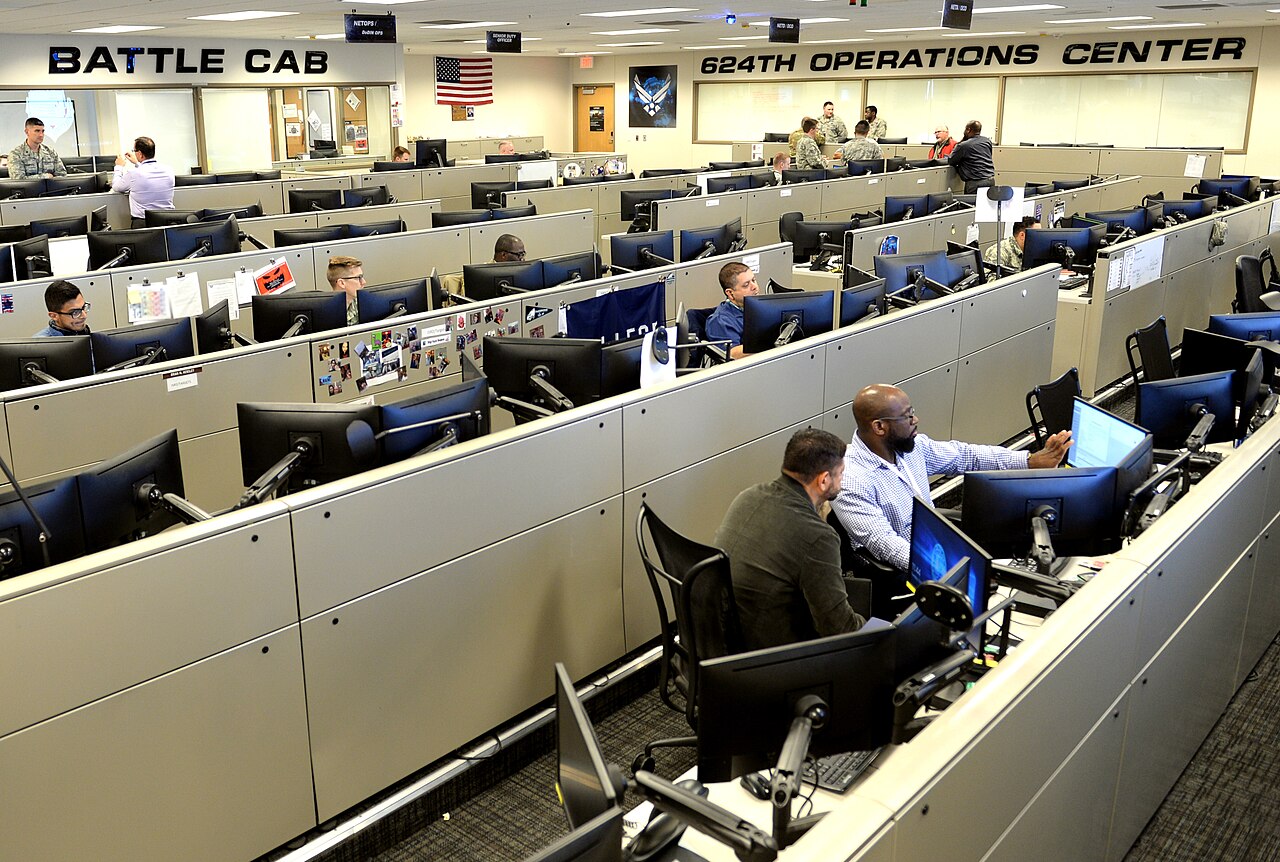
Members of the 624th Operations Center, which carries out cyber missions for Air Force and joint force commanders, at Joint Base San Antonio-Lackland, Texas, October 2018. Photo: U.S. Air Force, Tech. Sgt. R.J. Biermann, via Wikimedia Commons.
Today’s Long View argues that offensive cyber operations, not broadcasting and influence campaigns, belong at the center of the war on Iran that does not use bombs. It starts with the record the last eight months have already produced, turns to four places the advantage applies, and then makes the strongest case against going this way, because that case is real. The opening is free for every reader. The rest is for premium members, and every Forum donor reads it with the Forum’s compliments. The daily brief returns this week.
First Movers
In the war on Iran, the United States has a cyber advantage it has used quietly and a messaging habit it keeps funding loudly. The next phase should reverse the order.
On October 11, with the naval blockade holding and the President’s word that there will be no strike on Iran before the November midterms, Mohsen Rezaei, the secretary of Iran’s Supreme National Security Council, named the targets Tehran is studying. If the war returns, he said, “many cables, data centers and artificial intelligence centers will come within range.”
Take the threat at face value, because it is also a confession. The regime now treats the networks as a front, and it is right to. The question this essay asks is why the United States, which holds the advantage in that domain, keeps spending its attention and its money somewhere else.
For eight months Washington has fought Iran with bombs, a blockade, and sanctions. Alongside those runs a quieter war, the one meant to reach the regime without a warhead. In that quieter war the United States has two instruments. One is offensive cyber: operations that break the systems the regime runs on. The other is what the government still calls information operations: broadcasting, public diplomacy, and the influence campaigns the Pentagon and the State Department have run for twenty years. Washington funds the second loudly and uses the first quietly. The order should be the other way around.
This is not an argument that keyboards win wars. It is an argument about priority among the tools that do not fire. Of those tools, one has a record of measurable effect against Iran, and the other has a record of measurable disappointment. The money and the attention should follow the record.
“The regime now treats the networks as a front, and it is right to. Washington holds the advantage there and keeps spending its attention somewhere else.”
The Long View continues below for premium members: what the record already shows, the four places the advantage applies, and the honest case against going first. Every donor to the Middle East Forum receives premium membership with the Forum’s compliments; if your invitation has not arrived, write [email protected].


Subscribe to MEF Insider Premium to read the rest.
Become a paying subscriber of MEF Insider to get access to this post and other subscriber-only content.
UpgradeA subscription gets you:
- All premium articles, including the Long View and Sunday Briefing.
- Access to the entire Insider archive.
- Early access and discounts to MEF events.
- Quarterly virtual briefings from MEF experts.